Why wood does not scratch the coating
A non-stick coating is a thin polymer layer bonded to an aluminium or steel base. It is softer than any metal tool by a wide margin, which is why a steel spoon dragged across a hot pan can cut through it and leave a groove that food then sticks into.
Solid acacia sits somewhere else entirely. Acacia confusa has a density of 0.88–0.96 g/cm³ — denser than most soft mixed timber (0.55–0.65 g/cm³) and far denser than silicone, but still a wood product rather than a metal one. Our pieces are shaped and sanded so the working edges are rounded rather than sharp, so the contact point moves across the surface instead of digging into it.
We commissioned independent food-contact testing under FDA 21 CFR 175.300 and 21 CFR 178.3800 (report CTB26061806301C01, both tests PASS). That report covers the material and its finish; the non-stick question is a question of mechanics, and mechanics is what the rounded edge is for.
What wood actually does for your cooking
Wood is a poor conductor of heat compared with metal, and that is an advantage in a hot pan. A metal spatula turns a frying pan into a heat spreader and can scorch a delicate sauce on contact. A wooden turner lets you work the food without dumping the pan's heat straight into it, and the pan keeps a more even temperature while you stir.
Wood is also inert. It does not react with acidic food the way some metals can, and it will not take on a metallic taste the way a bare steel spoon left in a tomato sauce can. If you cook a lot of tomato, wine or vinegar-based sauces, that difference shows up in the first few bites.
When wood is the wrong tool
Wood is not universally the best answer, and a site that says otherwise is selling you something.
- Very hot, very long cooking. For a stockpot simmering for hours, a slotted metal spoon or a ladle that is rated for the job will outlast a wooden one. Wood handles routine stovetop heat — sauteing, frying, stirring — but it is not the right tool for a multi-hour boil at a rolling boil.
- Sticky, caramelised food. A wooden spoon can take on a residue if sugar or a thick reduction catches on it. The wash-it-right-away rule covers this.
- Anything that must be boiled dry. Leaving a wooden utensil sitting in a dry pan over heat is the fastest way to crack one.
Which BOKALAKA pieces belong on the hob
Every set is built for stovetop heat, and the pieces differ in how much work they do:
| Piece | What it is for on the hob |
|---|---|
| Slotted turner / slotted spatula | Flipping and lifting in a hot pan — the rounded slot edges are what keep the coating intact. |
| Solid turner | Saucing, scraping fond, moving heavier pieces. |
| Strainer spoon | Skimming and lifting from simmering liquid. |
| Ladle | Stirring and serving soup, stocks and sauce. |
| Mixing spoon | Stirring and folding, less often over direct heat. |
Our 10-piece set covers all five jobs, and the 12-piece classic set adds mixing and pasta-server shapes.
The one rule that matters
Wood is safe for non-stick pans as long as you look after it: hand wash, dry standing up, never the dishwasher, and never leave it standing in a hot pan. The care guide covers the routine in four steps, and our stirring and sauteing page goes deeper on hot-pan technique.
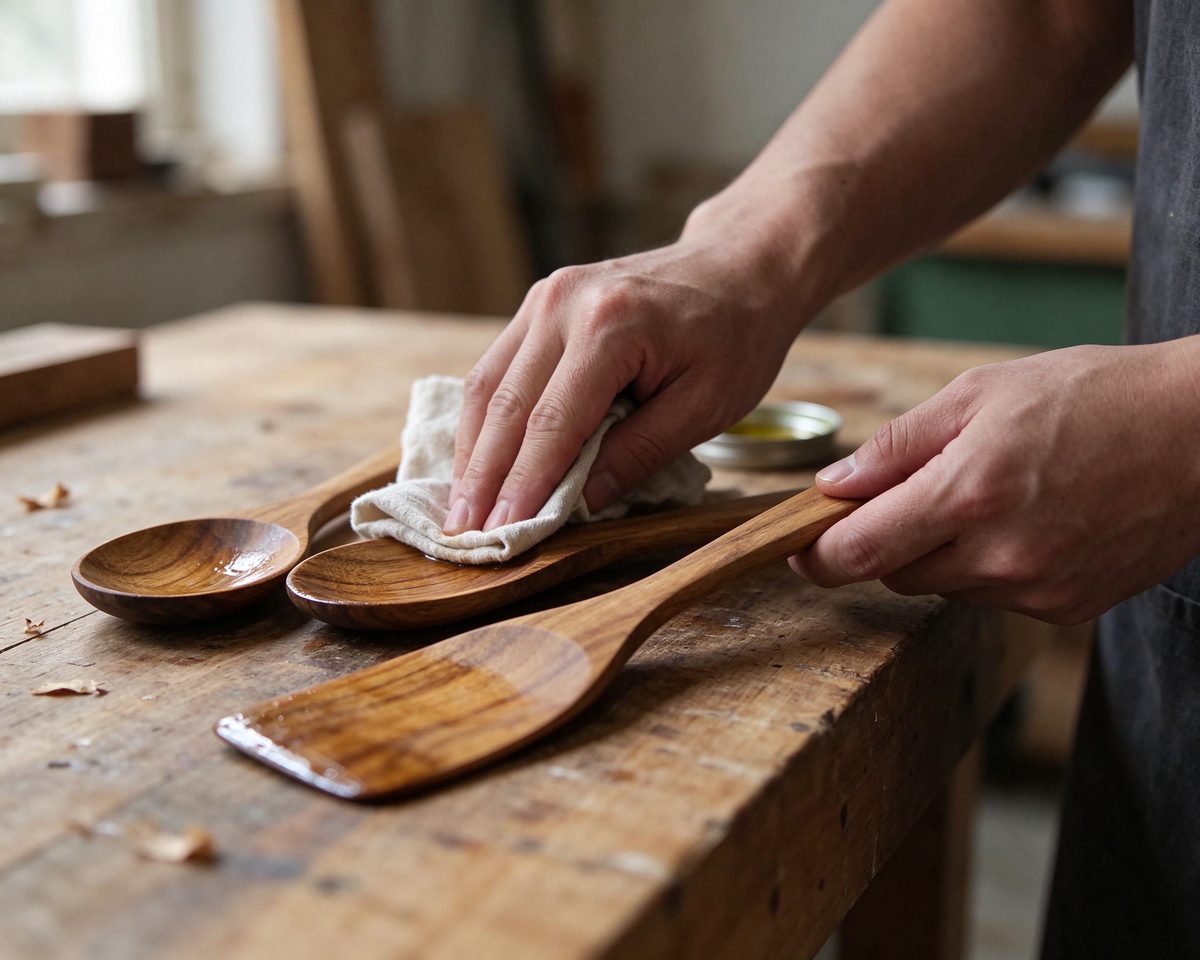
Wood is the right default for a non-stick pan, because it cannot scratch the coating, does not conduct heat into your food, and needs nothing more than hand washing and an occasional drop of oil to keep working.