
Wood
Wood wins on: non-stick and ceramic cookware, acidic foods, heat retention, and anything that should not scratch or conduct. Acacia confusa at 0.88–0.96 g/cm³ is a dense hardwood, so it holds its edge and resists softening — the opposite of fast-growing acacia auriculiformis or soft mixed timber, which are common in budget sets and dent or warp sooner.
Wood gives up on: very long boiling cooks, and it needs care — hand wash, dry standing up, re-oil when dry. Our care guide covers the routine.
See the piece-by-piece showcase for the shapes we make, or start with the 6-piece set.
Silicone
Silicone wins on: extreme heat tolerance and flexibility. It will not scratch a coating, it shrugs off heat that would damage wood, and it is the easiest thing to find in a cheap set.
Silicone gives up on: heat retention (it is a poor conductor, like wood), durability over years, and grip in a wet or oily hand. Lower-cost silicone also tends to be softer, which means it can deform at the joint and is more likely to harbour bacteria in its crevices. It is also heavier to look after: it cannot be re-oiled, only replaced.
Metal
Metal wins on: durability, thin edges that slide under food cleanly, boiling stocks and stocks that need a ladle for hours, and jobs that need a tool to take a beating.
Metal gives up on: non-stick coatings, which it will scratch; acidic foods, where bare steel can react and add a metallic taste; and heat, which it conducts straight into the food and straight onto your hand.
How we think about it
For a set that spends its life in a home kitchen — stirring, turning, serving, ladling — solid wood covers more of the important jobs than any one alternative. That is the reasoning behind our range, and the reasoning behind the coverage across all seven sets.
One material does not have to win every argument to be the right default for most home cooking. What matters is that the tool in your hand suits the pan in front of you.
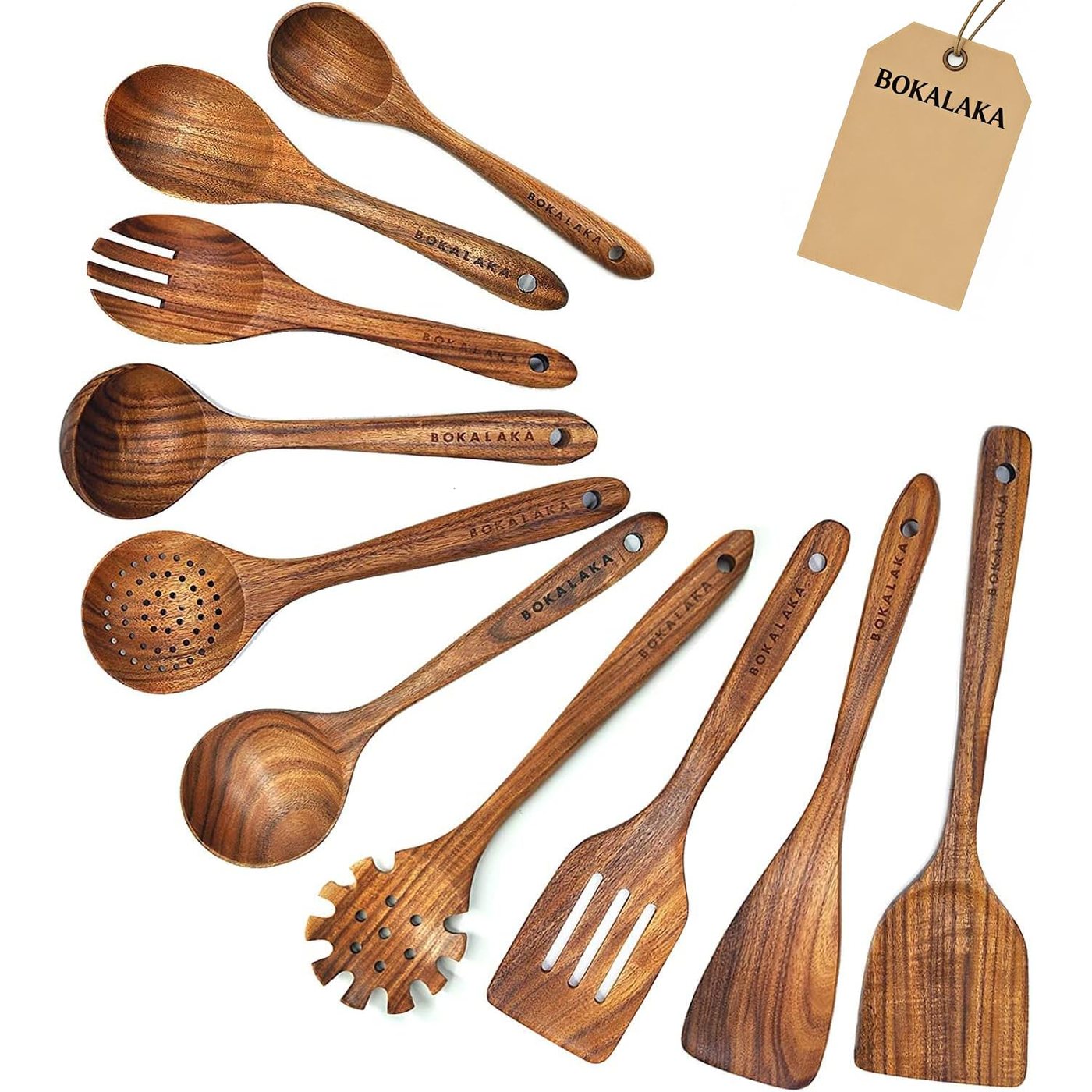
Wood covers more of the jobs a home kitchen actually has, and it is the only one of the three that can be re-oiled instead of replaced. Pick the material that suits the pan in front of you, not the one that wins every argument.